Start here: 20 questions, about 28 minutes. You see your level in every domain and which lessons to take first. Free, no card. You also get 36 practice questions a day: 9 easy, 9 medium, 9 hard and 9 challenging. See what’s free
×2 ×3Streaks pay. ×2 from three in a row, ×3 from six.
BestYour longest streak. Beat it tomorrow.
Full-length tests
The real test, rehearsed.
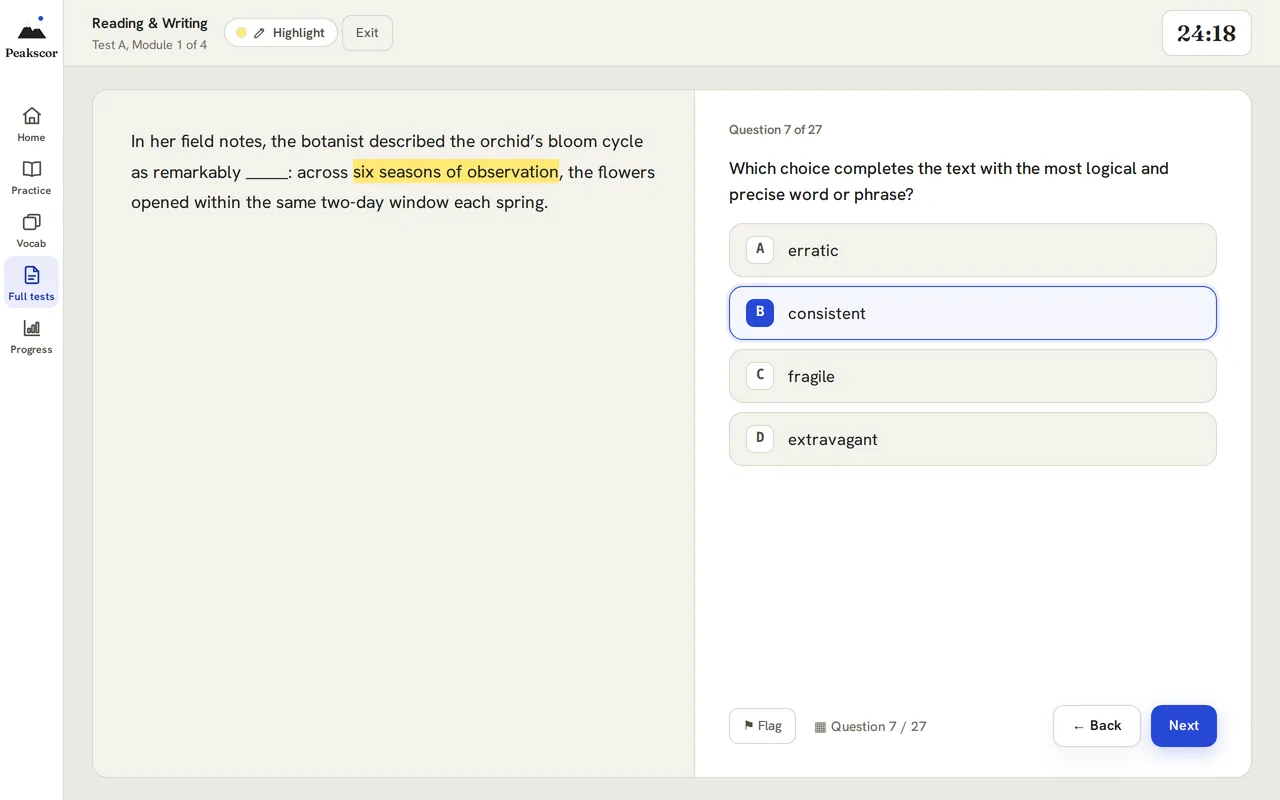
98 questions across four modules, in the digital SAT’s order and on its timing, with a highlighter, a question map and a timer you can see.
peakscor.com/tests
How it works
One run a day. One skill at a time.
The DailySTEP 4
Medium×2♥♥♥40
If 2x − 7 = 11, what is the value of 3x?
A9
B18
C27
Best: 3
1
Play the Daily.
A quick run with three hearts. String right answers together and the questions get harder and the points multiply.
Expression of IdeasTransitions
Jazz pianist Mary Lou Williams composed hundreds of works. ______ she wrote arrangements for bands led by Duke Ellington and Benny Goodman.
AHowever,Your pick
BIn addition,Correct
Why: the second sentence adds another accomplishment. Nothing is being contrasted.
2
Miss one, learn why.
Every question is tagged by domain and skill, and every answer comes with an explanation.
Practice
TransitionsHardIncorrect10 questions
Transitions40%
Boundaries78%
Inferences85%
Example accuracy by skill
3
Drill that skill.
Practice any single skill at any difficulty, or just the questions you got wrong.
Daily scoreEXAMPLE WEEK
709080110120140
New best: 140
4
Beat your best.
Come back tomorrow and climb. Progress shows your accuracy and your strongest skills.
Built around the real SAT blueprint.
Every question is tagged by section, domain, skill and difficulty, so you can practice exactly what you need. Full tests run like test day: two Reading & Writing modules, a break, then two Math modules.
The Daily, plus 36 practice questions every day: 9 easy, 9 medium, 9 hard and 9 challenging, each with a full explanation. Full-length Test A, Challenge Test 1 and all 1,023 vocabulary words are free too, as are the 20-question diagnostic, each Learn module’s overview and first lesson, and PEAK Survivor’s first map. No card needed.
Pro is $20 a month or $200 a year: unlimited practice with no daily limit, plus every full-length test and Challenge test, and every game map and level. Peak is $29 a month or $280 a year: everything in Pro, plus the full Learn course and Peak Plan. Cancel anytime from your account.
98 questions across four modules, in the digital SAT’s order: Reading & Writing Module 1 and Module 2 (27 questions each), a 10-minute break, then Math Module 1 and Module 2 (22 questions each). On official timing that’s 2 hr 14 min of testing. You get estimated section scores and a total at the end.
Yes. In the standard full-length tests, Module 2 of each section is the harder version if you get 60% or more of Module 1 right, and the easier version if you don’t. Challenge tests use the hardest material throughout.
Official timing, extended 1.5× time, or untimed, on every test, including the free ones. Extended time allows 48 minutes for each Reading & Writing module and about 52 for each Math module. Untimed removes the clock so you can focus on accuracy.
A quick run with three hearts. Each right answer builds your streak: the questions get harder as it grows, and your points multiply (×2 from three in a row, ×3 from six). A miss costs a heart and drops you back to easy. Best is your longest streak.
Every day at midnight Central Time. You get a fresh 9 easy, 9 medium, 9 hard and 9 challenging.
No. Peakscor is an independent SAT practice tool, not affiliated with the College Board. Scores shown are estimates.
Your next point starts today.
Free, no card.
Inference and margin of error · Lesson 2
What a margin of error means
A random sample gives an estimate, but a different random sample would give a slightly different one. The margin of error describes how far the estimate could plausibly be from the true population value.
Subtract it and add it. If a survey of a random sample of a city's adults estimates that 52% of them favor a later school start time, with a margin of error of 3%, the interval runs from 52−3=49 to 52+3=55, in percent. For a percent, the margin is in percentage points: 3% here means 3 points, not 3% of 52.
The SAT's wording for what this means: it is plausible that between 49% and 55% of all the city's adults favor a later start. Values inside the interval are plausible. Values outside it are less plausible, and the further outside, the less plausible.
The same reading works for a mean. If a random sample of a school's students spends a mean of 6.2 hours a week on homework, with a margin of error of 0.4 hours, it is plausible that the mean for all the school's students is between 5.8 and 6.6 hours. That says nothing about how long any one student spends.
A margin of error is reported at a confidence level, often 95%, so even the interval isn't a guarantee. What the SAT asks you to know is what the interval is about: the population's percent or mean, as a range of plausible values. The margin covers only the chance variation of random sampling (which members happened to be picked), not bias from a nonrandom sample or a misleading question.
What an estimate with a margin of error supports
Supported
Not supported
The true value is plausibly in the interval
The true value is exactly the estimate
A claim about the population's percent or mean
A claim about individual members
Plausible, reasonable to conclude
Certain, proven, guaranteed
The margin covers chance variation from random sampling
The margin covers bias from a nonrandom sample or a misleading question
Worked example Easy
A survey of a random sample of a city's registered voters found that 58% of those surveyed support building a new library. The margin of error for the survey is 4%.
Which of the following is the most appropriate conclusion about all registered voters in the city?
AExactly 58% of all the city's registered voters support building a new library.
BIt is plausible that 54% to 62% of the city's registered voters support it.Answer
CIt is certain that more than half of the city's registered voters support building it.
DThe margin of error shows that 4% of the voters surveyed gave inaccurate answers.
How to solve it
Build the interval: 58−4=54 and 58+4=62, so 54% to 62%.
The interval gives plausible values for the population, all the city's registered voters.
Of these four choices, only B uses the whole interval, names all the city's registered voters and says plausible, so it is the only one that says no more than the survey shows.
Why each choice is right or wrong
A. Incorrect. 58% is the estimate. The margin of error says the true percent could plausibly be anywhere from 54% to 62%, so exactly 58% claims more than the survey shows.
B. Correct. 58%±4% gives the interval 54% to 62%, and plausible is the right strength for a claim about the population.
C. Incorrect. The whole interval is above 50%, so a majority is a reasonable conclusion, but no sample makes it certain. The word certain claims more than a survey can show.
D. Incorrect. The margin of error isn't a count of wrong answers. It describes how far an estimate from a random sample could plausibly be from the population value just because of which people happened to be chosen.
Worked example Medium
A random sample of 200 adults who live in a county and commute to work were asked how long their commute takes. The mean commute time for the sample was 27 minutes, with a margin of error of 3 minutes.
Which of the following is the most appropriate conclusion?
AMost of the county's adults who commute to work have a commute that takes between 24 and 30 minutes.
BThe mean commute time of all the county's adults who commute to work is exactly 27 minutes.
CThe mean commute time of all the county's adults who commute to work is plausibly between 24 and 30 minutes.Answer
DThe mean commute time of all the state's adults who commute to work is plausibly between 24 and 30 minutes.
How to solve it
Build the interval: 27−3=24 and 27+3=30 minutes.
The interval is about the mean commute of the population the sample came from: the county's adults who commute to work.
Check each choice for the right quantity (the mean, not individuals), the right group (the county's commuters) and the right strength (plausibly, not exactly).
Why each choice is right or wrong
A. Incorrect. The interval is about the mean commute, not individual commutes. Individual commutes can spread far wider, from a few minutes to over an hour, while the mean stays near 27 minutes.
B. Incorrect. 27 minutes is the sample mean. The margin of error of 3 minutes says the mean for the county's commuters could plausibly be anywhere from 24 to 30 minutes.
C. Correct. 27±3 gives 24 to 30 minutes. The claim is about the mean, for exactly the population the sample came from, the county's adults who commute to work, and it says plausibly.
D. Incorrect. The sample was chosen from commuters in the county, so the conclusion applies only to the county. Commuters elsewhere in the state weren't sampled.
Trap Treating the estimate as the exact answer
Exactly 58% or the true mean is 27 minutes states the estimate as a fact. The true value is one number you don't know. The margin of error gives a range of plausible values for it, and the estimate is only the middle of that range.
Trap Reading a mean's interval as a range for individuals
An interval for a mean describes the population's average, not where each member falls. Most students spend between 5.8 and 6.6 hours on homework is a different claim, and the survey doesn't support it.
Trap Certainty words
Certain, proves and guarantees claim more than a random sample can show. A correct conclusion never overclaims. It may hedge with words such as plausible, reasonable to conclude or likely, or it may say what the data don't show. Careful words alone don't make a choice right, though: many wrong choices use them too. When a choice states a value for the population, the group, the quantity (a mean or percent, not individual values) and the numbers also have to match what was sampled, unless the choice is pointing out that the sample is biased.
Desmos When Desmos isn’t faster
Desmos isn't faster here. These are reading questions: the arithmetic is one subtraction and one addition, and the real work is matching the conclusion to what the interval describes.
If the interval has to become a count, such as 54% to 62% of 15,000 voters, you can type 0.5415000 and 0.6215000 on two lines, but mental math or any calculator is just as quick.
Your progress
How you’re doing across daily practice and full-length tests.
Choose a section, then practice a whole domain or drill a single skill.
Difficulty
Status
Session
Timing
Full-length tests
Each test mirrors the digital SAT: 98 questions across four modules, 2 hr 14 min on official timing.
A little harder than the real SAT. These tests can run slightly tougher than test day, which makes them good practice: if you can handle these, the real one should feel easier. No question appears in more than one test, Challenge Tests included.
Challenge Tests Hardest of the hardest
Same 98-question format, but every question is drawn from the toughest SAT material: Challenging-tier math throughout and the hardest reading.
Vocab
Study the classic SAT vocabulary list. Browse, flip flashcards, or quiz yourself.
Free every day. Pro when you're serious.
Practice free every day. Pro removes the limits. Peak adds the full course and a plan to test day.
FREE
$0forever
✓ 9 easy + 9 medium + 9 hard + 9 challenging daily
✓ Practice by any SAT domain
✓ Explanations on every question
✓ Test A and Challenge Test 1
✓ Each Learn module’s overview and first lesson
✓ The 20-question Learn diagnostic
✓ PEAK Survivor’s first map, plus the opening levels of Hole and Peak Defense
PRO
$200/ year
About $16.67 a month, save $40
✓ Everything in Free
✓ Unlimited daily practice
✓ Every full-length and Challenge test
✓ Every game map and level, with progress saved
Full course and plan
PEAK
$280/ year
About $23.33 a month, save $68
✓ Everything in Pro
✓ Every Learn lesson, summary and mastery quiz
✓ Peak Plan: a day-by-day plan to test day
✓ Cancel anytime
Prices in USD. Switch or cancel your plan at any time.
Pro checkout isn’t open yet
Online payment hasn’t launched, so nothing here asks for a card. Everything on the free plan stays free.
Peak, yearly$280 / year
Log in
Save your progress and pick up where you left off.
Your account keeps game coins, characters and map progress in sync across devices. Practice history stays on this device.
Your account
▦ Calculator
Drag the bar to move it, and the corner to resize it