Digital SAT®
- Reading and Writing and Math practice by domain, skill and difficulty
- Two free full-length tests on official timing: Test A and Challenge Test 1
- The Daily, 1,023 vocabulary words and practice games
SAT® · ACT® · AP®
Original questions with every answer explained, full-length practice tests and a plan to test day. Pick your test to begin. You can switch any time.
36 free practice questions a day, shared across all your practice, each with a full explanation. No card needed.
36 practice questions every day, each with a full explanation, shared across your SAT, ACT and AP practice. The SAT and ACT diagnostics, SAT full-length Test A and Challenge Test 1, ACT Practice Test 1, The Daily and all 1,023 SAT vocabulary words are free too. No card needed.
The digital SAT, the ACT and AP exams. Choose a test at the top of this page. The ACT side has English, Math, Reading and Science practice, lessons, a 20-question diagnostic and full-length practice tests. The AP side has practice by unit and topic and full-length practice exams. Every question is original.
ACT and AP practice use the same free daily questions as SAT practice. The 20-question ACT diagnostic and ACT Practice Test 1 are free too. Other ACT practice tests and the AP practice exams come with Pro.
Every day at midnight Central Time.
No. Peakscor is an independent practice tool, not affiliated with College Board or ACT Education Corp. Scores shown are estimates.
Reach your peak.
A quick run every day, an explanation for every question, and full-length tests on official timing.
Full-length tests
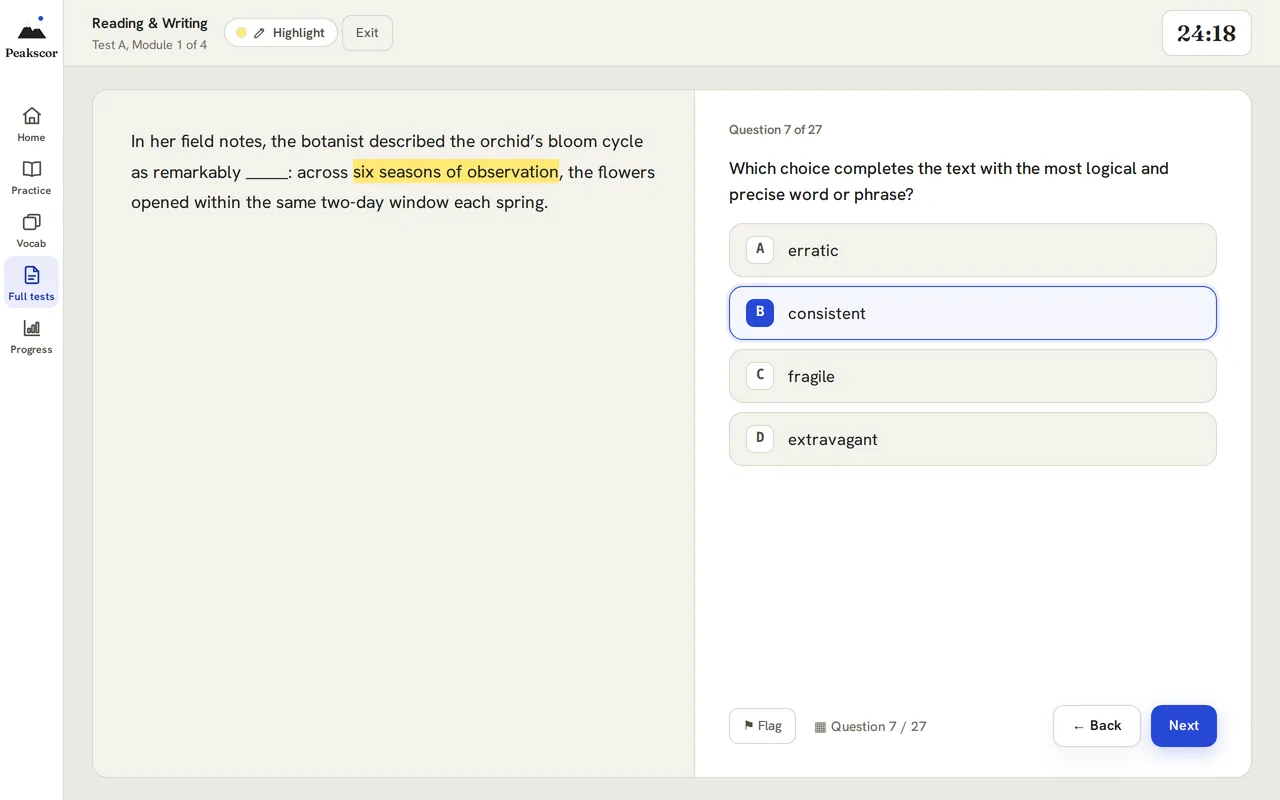
98 questions across four modules, in the same order and on the same timing as the digital SAT, with a highlighter, a question map and a timer you can see.
How it works
A quick run with three hearts. String right answers together and the questions get harder and the points multiply.
Every question is tagged by domain and skill, and every answer comes with an explanation.
Practice any single skill at any difficulty, or just the questions you got wrong.
Come back tomorrow and climb. Progress shows your accuracy and your strongest skills.
Every question is tagged by section, domain, skill and difficulty, so you can practice exactly what you need. Full tests run like test day: two Reading & Writing modules, a break, then two Math modules.
9 easy, 9 medium, 9 hard and 9 challenging questions free every day, each with a full explanation. Filter by section, domain, skill and difficulty. Resets at midnight Central Time.
Take any test on official timing, extended 1.5× time, or untimed to focus purely on accuracy.
Four modules in official order. The second module of each section adapts to how you did on the first.
1,023 essential SAT words. Browse the list, flip flashcards, or quiz yourself.
Accuracy across daily practice and full tests, your strongest skills, and the ones that need the most help.
PEAK Survivor, Peak Hoover and Peak Defense: three games powered by SAT practice questions.
Explanations
Not just the right letter: how to get there, and why the tempting answer is wrong.
A store raises the price of a jacket by 20%. Later, it lowers the new price by 20%. The final price is what percent of the original price?
Check with $100: $100→then$120→then$96
Up 20% means × 1.20. Down 20% means × 0.80.
1.20 × 0.80 = 0.96
The final price is 96% of the original. That’s B.
The 20% cut is taken from the higher price, so it removes more than the 20% increase added.
Test day
Every Peakscor full test follows this order. In the standard tests, the second module of each section adapts to how you did on the first.
27 questions32 min
27 questions32 min
10 min
22 questions35 min
22 questions35 min
98 questions · 2 hr 14 min of testing, plus the break
Plans
The free plan is the real thing, not a trial. Pro removes the limits. Peak adds the full course and a plan to test day.
$0no card needed
$20a month, or $200 a year
$29a month, or $280 a year
Prices in US dollars. Cancel anytime.
FAQ
The Daily, plus 36 practice questions every day: 9 easy, 9 medium, 9 hard and 9 challenging, each with a full explanation. Full-length Test A, Challenge Test 1 and all 1,023 vocabulary words are free too, as are the 20-question diagnostic and PEAK Survivor’s first map. No card needed.
Pro is $20 a month or $200 a year: unlimited practice with no daily limit, plus every full-length test and Challenge test, and every game map and level. Peak is $29 a month or $280 a year: everything in Pro, plus the full Learn course and Peak Plan. Cancel anytime from your account.
98 questions across four modules, in the same order as the digital SAT: Reading & Writing Module 1 and Module 2 (27 questions each), a 10-minute break, then Math Module 1 and Module 2 (22 questions each). On official timing that’s 2 hr 14 min of testing. You get estimated section scores and a total at the end.
Yes. In the standard full-length tests, Module 2 of each section is the harder version if you get 60% or more of Module 1 right, and the easier version if you don’t. Challenge tests are built from harder material in every module.
Official timing, extended 1.5× time, or untimed, on every test, including the free ones. Extended time allows 48 minutes for each Reading & Writing module and about 52 for each Math module. Untimed removes the clock so you can focus on accuracy.
A quick run with three hearts. Each right answer builds your streak: the questions get harder as it grows, and your points multiply (×2 from three in a row, ×3 from six). A miss costs a heart and drops you back to easy. Best is your longest streak.
Every day at midnight Central Time. You get a fresh 9 easy, 9 medium, 9 hard and 9 challenging.
No. Peakscor is an independent SAT practice tool, not affiliated with the College Board. Scores shown are estimates.
Free, no card.
Integration of Ideas · Lesson 2
Some ACT Reading passages include a table, graph, or figure. The questions about it are not science questions: they ask you to read the graphic carefully and connect it to the text. Everything you need is on the page.
Read the graphic in this order. First, the title or label (Table 1) and the sentence in the passage that introduces it, so you know what was measured and why. Second, the headers and units: Time to double (min) is minutes, not hours, and a percent is not a count. Third, find the row and column the question names, and put your finger, or the line reader, on that cell.
For a pattern question, compare the numbers in order. Does each value go up, go down, or change unevenly? Then check the choice's exact wording: rose every year, more than doubled, and by the same amount are three different claims, and the table may support only one of them.
| The stem says... | Your job |
|---|---|
| According to Table 1, ... | Find one cell: the named row and column. Watch units. |
| The data best support which statement? | Test each choice against the numbers; one detail wrong makes the choice wrong. |
| The phrase in paragraph 2 refers to which results? | Translate the passage's words into specific rows of the table. |
| Which prediction is most consistent with...? | Use the trend and the author's explanation together; don't invent a new rule. |
Bakers have long known that bread dough rises faster in a warm kitchen, but they rarely measure how much faster. A group of students in a cooking class decided to find out. They mixed one large batch of dough, divided it into equal portions, and let each portion rise in a cabinet held at a different temperature. They recorded how long each portion took to double in volume.
The results, shown in Table 1, matched the bakers' rule of thumb within the range the students tested. The students noticed, though, that the effect was not even: the warmest step saved far less time than the coolest one. They suspect that the yeast was already working close to its fastest pace in the warmer cabinets, so additional warmth had less room to help.
Table 1
| Cabinet temperature (°C) | Time to double (min) |
|---|---|
| 18 | 210 |
| 22 | 150 |
| 26 | 110 |
| 30 | 90 |
| 34 | 80 |
According to Table 1, how long did the dough take to double in volume in the cabinet held at 26°C?
Bakers have long known that bread dough rises faster in a warm kitchen, but they rarely measure how much faster. A group of students in a cooking class decided to find out. They mixed one large batch of dough, divided it into equal portions, and let each portion rise in a cabinet held at a different temperature. They recorded how long each portion took to double in volume.
The results, shown in Table 1, matched the bakers' rule of thumb within the range the students tested. The students noticed, though, that the effect was not even: the warmest step saved far less time than the coolest one. They suspect that the yeast was already working close to its fastest pace in the warmer cabinets, so additional warmth had less room to help.
Table 1
| Cabinet temperature (°C) | Time to double (min) |
|---|---|
| 18 | 210 |
| 22 | 150 |
| 26 | 110 |
| 30 | 90 |
| 34 | 80 |
The students' observation that "the warmest step saved far less time than the coolest one" compares the change between which two pairs of temperatures in Table 1?
Many wrong choices are real numbers from the table, just from the row above or below, or from a different column (days instead of seedlings, a percent instead of a count). That is why they look familiar. Before you choose, name the row and the column out loud to yourself.
Watch for half, twice, tripled, and by the same amount. A choice that says 80 is "less than half" of 150 is wrong, because half of 150 is 75. Do the small arithmetic; don't trust that a big drop is "half."
How you’re doing across daily practice and full-length tests.
Your sign-in, plan and preferences, in one place.
To change it we email a 6-digit code to your address first, so only you can do it. Your password is never shown or stored on this device.
Manage billing opens Stripe, where you can change or cancel your plan, update your card and download receipts.
Choose a section, then practice a whole domain or drill a single skill.
Each test mirrors the digital SAT®: 98 questions across four modules, 2 hr 14 min on official timing.
Same 98-question format, built from harder material: a hard Module 1, then a Module 2 made mostly of the hardest questions.
Study the classic SAT® vocabulary list. Browse, flip flashcards, or quiz yourself.
Practice free every day. Pro removes the limits. Peak adds the full course and a plan to test day.
Prices in USD. Switch or cancel your plan at any time.
Last updated October 10, 2026
Peakscor is an independent SAT®, ACT® and AP® practice website at peakscor.com, built and run by its student founders in Houston, Texas. This policy explains what we collect, why, and what you can do about it. If anything here is unclear, email support@peakscor.com.
Some things are saved only in your browser’s local storage and are never sent to us: the calculator’s layout and saved entries, your practice difficulty and timing, the test you chose last (SAT, ACT or AP), your light or dark theme, your best scores on the Daily, today’s practice numbers, a test in progress, the questions you’ve seen recently, and the copies of missed questions in your mistake notebook. Your game and study settings, your practice and full-test results, your study plan and your diagnostic result are kept in your browser too, and a copy is saved to your guest account or account so they can follow you to another device (see below). You can remove the browser copies by clearing your browser’s site data for peakscor.com.
Your daily free-question count is kept in your browser and on our servers, counted per account and per browser, so the free limit works the same in a private window. The browser is identified only by a scrambled (hashed) version of its random ID, and each count is just a number of questions per difficulty for that day.
So your progress can save, Peakscor creates an anonymous guest account in the background when you visit. It has no name or email address. It is tied to a random ID created when you first visit. It stores:
When you answer a Practice question correctly, finish a lesson, master a module, finish the diagnostic or finish a game, you earn points. We store each award with what earned it (for example a question or lesson ID), the points, the day and the time, plus how long you took to answer, and the league tier you are in. Each week you are placed in a league of up to 30 students at your level. Other students in your league see your display name, your points that week and your rank. They never see your email or anything else about you. Turn on “Hide me from leaderboards” on the Leagues page to stop showing up on any leaderboard right away; you still earn points and see your own total. Points from every test (SAT, ACT and AP) count toward the same weekly league; only you see how your points split by test. Points and league results are kept until you delete your account.
As you study, you earn badges (for example for a 7-day streak, finishing the diagnostic or mastering a unit) and outfits for Kip, the Peakscor mascot. We work them out on our server from what you have already done on Peakscor, and store which badges you earned, when, and which outfit Kip is wearing. Badges and outfits can only be earned, never bought. Other students don’t see your badges. They are kept until you delete your account.
If you start or join a duel, we store that you are one of its two players (your account ID, never a name or email), the five questions, each answer you give (which choice, whether it was right and how long it took), your score and any points it earned you. The other player sees your display name, how many questions you have answered, whether you got each one right once they have answered it too, and your final score. They never see which choice you picked, your email or anything else about you. If you hide yourself from leaderboards, they see “A climber” instead of your name. Anyone you send the link to sees your display name on the invite. Each duel belongs to one test (SAT, ACT or AP), and both players see which. A duel and its answers are deleted 30 days after it ends.
Reminders (push notifications), only if you turn them on. When you tap “Turn on reminders” and allow notifications, your browser gives us a push address and two encryption keys for this device. We store them with your account id, your time zone (so we never send before 8 AM or after 9 PM where you are) and the date of the last reminder. We send at most one reminder a day: a duel waiting for your turn, your Summit Sprint day, a streak about to slip, or league news. They never include your name, score or email. Turn them off any time on Home, in Progress or in your account (one tap removes every device); deleting your account deletes them too. Unused for 120 days, they are deleted.
If you join a teacher’s class, we store that you are in the class and the nickname you choose for it. Please don’t use your real name. The teacher sees your nickname and a short summary of your studying: active days in the last week, Learn lessons completed and modules mastered, your diagnostic levels, your practice accuracy by topic, and whether you have finished their assignments. The teacher never sees your email address or your answers, and other students never see your data. If you leave the class, or the teacher removes you, the teacher no longer sees any of it. A teacher’s account stores the class name and its join code.
Like any website, our hosting providers process your IP address and basic request details (such as browser type) to deliver pages and keep the service secure. A sign-in token for your guest account or account is kept in your browser’s local storage. When someone makes an account, we keep the email address they signed up with and scrambled (hashed) versions of their IP address and browser ID for up to 31 days, only to stop disposable email addresses and limit how many accounts one network or browser can create. If a page breaks, your browser may send us a short error report: what went wrong, which page it happened on (without anything after the “?” in the address), the site version and your browser type. Email addresses and sign-in tokens are removed from it, and it doesn’t include your user ID or email address. We keep error reports for about 30 days. We don’t use advertising cookies or third-party analytics tools.
Kip is Peakscor’s study helper. Kip is an AI (a computer program), not a person, and it can make mistakes, so check anything important against the lesson or the question’s explanation. Kip is turned off during full tests, the diagnostic and mastery quizzes.
Anthropic handles messages for us as a service provider, under its commercial terms. Those terms say Anthropic doesn’t use them to train its AI models. Anthropic deletes them within 30 days, except that it can keep a message for up to 2 years if its safety systems flag it as breaking Anthropic’s usage policy, or for longer if the law requires.
For each account and guest account, we count how many messages were sent each day and estimate what they cost, so the daily limits work. We keep these counts for 90 days. For the whole site, without recording who, we also count how many times each kind of safety topic came up each day (for example, someone asking Kip to help cheat, or someone who seemed to be in crisis). None of these counts include anything anyone wrote.
Kip answers a limited number of messages a day: right now 10 on the free plan (and for guests), 30 on Pro and 60 on Peak. Limits reset at midnight Central Time. We may change them, and Kip may take a break for everyone for the rest of the day if Kip’s daily budget runs out.
Open Kip’s menu and choose Delete history to erase every chat with Kip on that device. Signing out or deleting your account also clears them. Messages already sent to Anthropic are deleted on Anthropic’s schedule above.
Kip is a study helper, not a counselor. Nobody at Peakscor reads your chats, so Kip can’t send anyone to help you. If you’re thinking about hurting yourself or you don’t feel safe, call or text 988 (the Suicide & Crisis Lifeline) any time, day or night, and tell a trusted adult, like a parent, school counselor or teacher, right away. If you’re in immediate danger, call 911.
Only to run Peakscor: to sign you in, save and sync your progress, grade questions, answer your questions to Kip, show leaderboards, keep the service secure and fair, handle payments if you buy a plan, and reply when you contact us. We don’t use your data for advertising, and we don’t use it to train AI models.
We don’t sell or rent personal information. We use a small number of service providers who process data only to run Peakscor:
We may also share information if the law requires it, or to protect the safety of students or the security of the service.
Game leaderboards are public and show your display name and your scores. They never show your email address. If you join a class, its teacher sees the summary described under “Classes”. In a duel, the other player sees what is described under “Duels”. Other students in your weekly league see your display name, points that week and rank, and the Summit Sprint board shows your display name, days climbed and sprint points, unless you turn on “Hide me from leaderboards”. Nothing else about your account is public.
Peakscor is meant for students 13 and older, and we don’t knowingly collect personal information from children under 13. If you believe a child under 13 has made an account, email us and we will delete it.
These choices are available to everyone, wherever you live.
We keep account and guest data until it is deleted. Duels are deleted 30 days after they end. Kip message counts are kept for 90 days, and your chats with Kip stay on your device until you delete them. When you delete your account, it is erased from our database right away. Copies in our providers’ encrypted backups are overwritten on their normal schedule, usually within a few weeks.
All traffic is encrypted. Every database table has access rules so that each student can read only their own records, and those rules are tested automatically whenever the code changes. No system is perfectly secure, so if you think something is wrong, tell us right away.
Peakscor is independent. It isn’t provided by or through any school, and we don’t receive student records from schools. A teacher can make a Peakscor class and invite students with a code; joining is up to each student, and the teacher sees only the class summary described under “Classes”.
If we change this policy, we will update the date at the top. If a change affects how we use data you’ve already given us, we will tell you on the site before it takes effect.
Questions or requests: support@peakscor.com.
Last updated October 10, 2026
These terms cover your use of Peakscor at peakscor.com. By using Peakscor, you agree to them. If you don’t agree, please don’t use the site.
You must be at least 13 years old. If you are under 18, please read these terms with a parent or guardian, and get their permission before buying a plan.
Keep your sign-in details private, use your own email address, and don’t share your account. You are responsible for what happens on your account. You can delete it at any time from the account menu.
The free plan is free and needs no card. Paid plans (Pro and Peak) unlock more practice, tests and lessons, as described on the Pricing page. Online payment has not launched yet. When it does, these rules apply:
Please don’t:
Peakscor’s questions, explanations, lessons, games and design are our original work and belong to Peakscor. You may use them for your own studying. Teachers and tutors who want to use them with students should email us first. Read how our questions are made.
If you send us feedback or report a problem with a question, we may use it to improve Peakscor without owing you anything.
Peakscor is an independent practice tool. It is not affiliated with, endorsed by or sponsored by the College Board or ACT Education Corp. Our questions are original practice in the style of each test, not official test questions. Scores shown on Peakscor are estimates, and we don’t promise any particular result on the SAT, the ACT or any AP exam.
SAT®, AP® and Advanced Placement® are trademarks registered by the College Board, which is not affiliated with, and does not endorse, Peakscor. PSAT/NMSQT® is a registered trademark of the College Board and the National Merit Scholarship Corporation, which are not affiliated with, and do not endorse, Peakscor. Bluebook™ is a trademark of the College Board. ACT® is a registered trademark of ACT Education Corp., which is not affiliated with, and does not endorse, Peakscor. Desmos is a trademark of Desmos Studio PBC.
If you believe something on Peakscor copies your work or misuses your trademark, email support@peakscor.com and tell us what it is and where it appears. We will reply within one business day and take the content down while we review it.
We work hard to make Peakscor accurate and reliable, but it is provided “as is.” Questions or explanations may sometimes contain mistakes, and the site may sometimes be unavailable.
To the extent the law allows, Peakscor is not liable for indirect or consequential losses, and our total liability for any claim is limited to the amount you paid us in the 12 months before the claim, or $50 if you paid nothing.
You can stop using Peakscor at any time. We may suspend accounts that break these terms. If we ever shut Peakscor down, we will refund the unused part of any paid subscription.
These terms are governed by the laws of the State of Texas.
We may update these terms. We will change the date at the top, and tell you on the site about any important change before it takes effect.
Last updated October 10, 2026
Every question, passage, explanation and lesson on Peakscor is original practice in the style of the test it prepares you for. None of it is an official SAT®, ACT® or AP® question, and we are not affiliated with the College Board or ACT.
Scores on Peakscor are estimates based on how you do on our practice questions. They are not official scores and don’t predict an exact result. ACT scores come from our own model, not from ACT conversion tables.
If a question looks wrong, or you think something is too close to published material, email support@peakscor.com. We reply within one business day and take reported content down while we review it.
Online payment hasn’t launched, so nothing here asks for a card. Everything on the free plan stays free.
Save your progress and pick up where you left off.
Your account keeps game coins, characters and map progress in sync across devices. Practice history stays on this device.
By continuing, you agree to the Terms and Privacy Policy and confirm you’re 13 or older.