Free
$0no card needed
- The Daily, every day
- 36 practice questions a day, each with an explanation: 12 easy, 12 medium, 12 hard
- Full-length Test A and Challenge Test 1
- All 1,023 vocabulary words: browse, flashcards and quiz
Reach your peak.
A quick run every day, an explanation for every question, and full-length tests on official timing.
Full-length tests
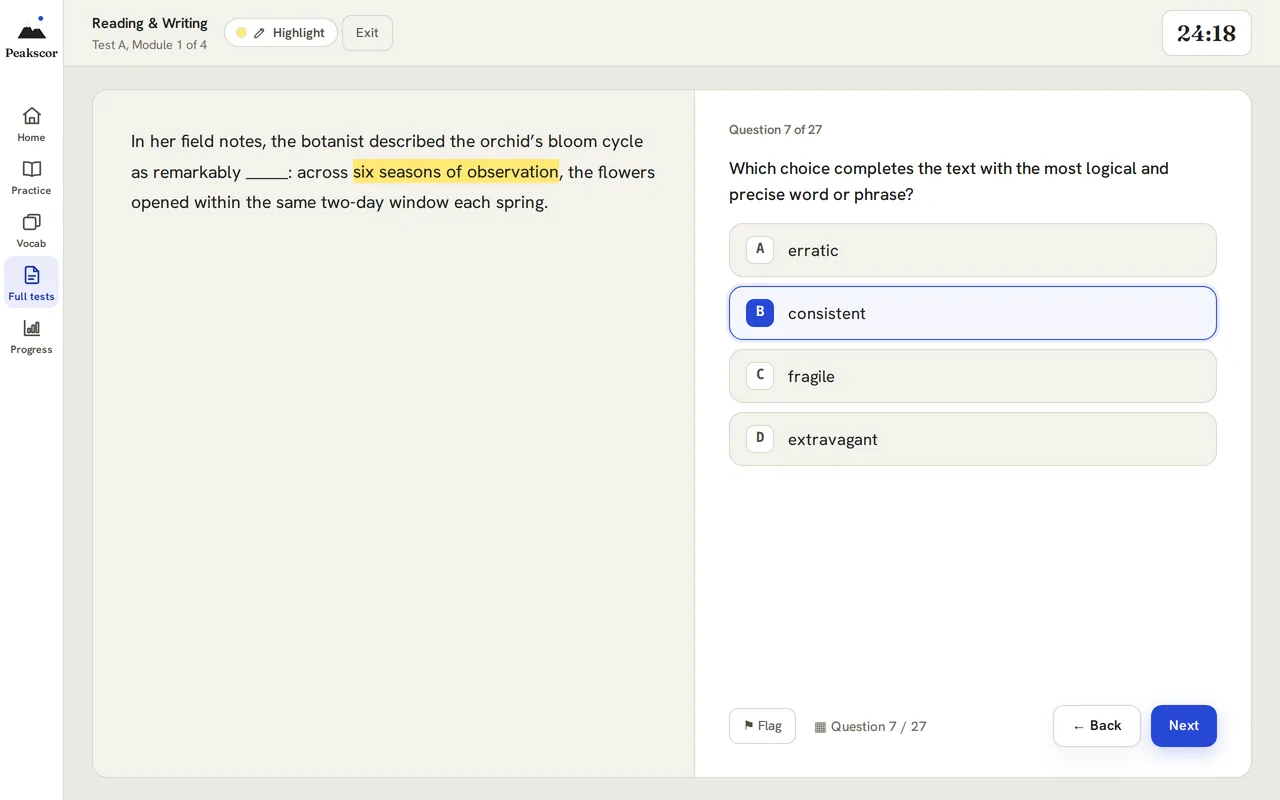
98 questions across four modules, in the digital SAT’s order and on its timing, with a highlighter, a question map and a timer you can see.
How it works
A quick run with three hearts. String right answers together and the questions get harder and the points multiply.
Every question is tagged by domain and skill, and every answer comes with an explanation.
Practice any single skill at any difficulty, or just the questions you got wrong.
Come back tomorrow and climb. Progress shows your accuracy and your strongest skills.
Every question is tagged by section, domain, skill and difficulty, so you can practice exactly what you need. Full tests run like test day: two Reading & Writing modules, a break, then two Math modules.
12 easy, 12 medium and 12 hard questions free every day, each with a full explanation. Filter by section, domain, skill and difficulty. Resets at midnight.
Take any test on official timing, extended 1.5× time, or untimed to focus purely on accuracy.
Four modules in official order. The second module of each section adapts to how you did on the first.
1,023 essential SAT words. Browse the list, flip flashcards, or quiz yourself.
Accuracy across daily practice and full tests, your strongest skills, and the ones that need the most help.
PEAK Survivor, Hole and Peak Defense: three games powered by SAT practice questions.
Explanations
Not just the right letter: how to get there, and why the tempting answer is wrong.
A store raises the price of a jacket by 20%. Later, it lowers the new price by 20%. The final price is what percent of the original price?
Check with $100: $100→then$120→then$96
Up 20% means × 1.20. Down 20% means × 0.80.
1.20 × 0.80 = 0.96
The final price is 96% of the original. That’s B.
The 20% cut is taken from the higher price, so it removes more than the 20% increase added.
Test day
Every Peakscor full test follows this order. In the standard tests, the second module of each section adapts to how you did on the first.
27 questions32 min
27 questions32 min
10 min
22 questions35 min
22 questions35 min
98 questions · 2 hr 14 min of testing, plus the break
Plans
The free plan is the real thing, not a trial. Pro removes the limits. Peak adds the full course and a plan to test day.
$0no card needed
$20a month, or $200 a year
$29a month, or $280 a year
Prices in US dollars. Cancel anytime.
FAQ
The Daily, plus 36 practice questions every day: 12 easy, 12 medium and 12 hard, each with a full explanation. Full-length Test A, Challenge Test 1 and all 1,023 vocabulary words are free too. No card needed.
Pro is $20 a month or $200 a year: unlimited practice with no daily limit, plus every full-length test and Challenge test. Peak is $29 a month or $280 a year: everything in Pro, plus the full Learn course and Peak Plan. Cancel anytime from your account.
98 questions across four modules, in the digital SAT’s order: Reading & Writing Module 1 and Module 2 (27 questions each), a 10-minute break, then Math Module 1 and Module 2 (22 questions each). On official timing that’s 2 hr 14 min of testing. You get estimated section scores and a total at the end.
Yes. In the standard full-length tests, Module 2 of each section is the harder version if you get 60% or more of Module 1 right, and the easier version if you don’t. Challenge tests use the hardest material throughout.
Official timing, extended 1.5× time, or untimed, on every test, including the free ones. Extended time allows 48 minutes for each Reading & Writing module and about 52 for each Math module. Untimed removes the clock so you can focus on accuracy.
A quick run with three hearts. Each right answer builds your streak: the questions get harder as it grows, and your points multiply (×2 from three in a row, ×3 from six). A miss costs a heart and drops you back to easy. Best is your longest streak.
Every day at midnight. You get a fresh 12 easy, 12 medium and 12 hard.
No. Peakscor is an independent SAT practice tool, not affiliated with the College Board. Scores shown are estimates.
Free, no card.
Cross-Text Connections · Lesson 3
Many Text 2 authors don't simply agree or disagree. They accept one part of Text 1 and push back on another. To see which, split Text 1 into its finding (what was observed or measured) and its conclusion (what the author says it means or why it happened).
Then ask which part Text 2 accepts. Three patterns are common. Same finding, different explanation: Text 2 agrees on what happened but gives another cause. Accepted, but limited: Text 2 agrees the claim holds in some places, groups or conditions, but not all. Questioned evidence: Text 2 doesn't call the conclusion false, but shows the evidence can't support it as strongly as Text 1 says, for example because the study ran too briefly to show a lasting effect.
The right answer matches what Text 2 accepts as well as what it disputes. It may state both halves or only the dispute, but it never contradicts the part Text 2 accepts. Wrong answers often miss in one of two directions: too strong (Text 2 rejects everything) or too weak (Text 2 agrees completely).
Text 1
In the city of Sendara, zoologist Kenji Mori watched crows place walnuts on a busy crosswalk, let passing cars crush them, and then fly down to collect the pieces. The crows collected the nuts almost only while the light was red and cars were stopped. Mori argues that the crows understand what the traffic signals mean.
Text 2
Biologist Leah Varga agrees that the crows' timing is impressive, but she doubts that they are reading the lights. A red light, she notes, is always followed by stopped cars and people stepping into the street. Crows, which are skilled at tracking movement, could simply be waiting for those signs that the road is safe.
Based on the texts, how would Varga (Text 2) most likely respond to Mori's argument in Text 1?
Text 1
In the Velmark region, the share of brides and grooms who signed the marriage register with their names, rather than with a mark, rose from 30 percent in 1650 to 55 percent in 1700. Historian Clara Brandt links this rise in literacy to the printing presses that opened in Velmark's towns, which flooded the region with cheap books.
Text 2
Historian Jonas Eklund accepts that literacy rose sharply in Velmark after 1650. But he notes that a 1652 law required every parish to fund a village school, and that signing rates climbed just as fast in remote villages with no bookseller for miles as in the towns where the presses were. Eklund credits the schools, not the presses, for the rise.
Based on the texts, how would Eklund (Text 2) most likely respond to Brandt's explanation in Text 1?
A choice may have Text 2 rejecting Text 1 completely, or saying something has no effect, when Text 2 only limits or questions the claim. Watch for absolute words such as no, never, all and entirely, and check that Text 2 really goes that far.
When Text 2 accepts Text 1's observation (agrees that..., accepts that...), a choice that has Text 2 doubting that observation is wrong, however reasonable the doubt sounds. Find the exact part Text 2 pushes back on.
Choose a section, then practice a whole domain or drill a single skill.
Each test mirrors the digital SAT: 98 questions across four modules, 2 hr 14 min on official timing.
Same 98-question format, but every question is drawn from the toughest SAT material: Challenging-tier math throughout and the hardest reading.
Study the classic SAT vocabulary list. Browse, flip flashcards, or quiz yourself.
Practice free every day. Pro removes the limits. Peak adds the full course and a plan to test day.
Prices in USD. Switch or cancel your plan at any time.
Online payment hasn’t launched, so nothing here asks for a card. Everything on the free plan stays free.
Save your progress and pick up where you left off.
Your account keeps game coins, characters and map progress in sync across devices. Practice history stays on this device.