Free
$0no card needed
- The Daily, every day
- 36 practice questions a day, each with an explanation: 12 easy, 12 medium, 12 hard
- Full-length Test A and Challenge Test 1
- All 1,023 vocabulary words: browse, flashcards and quiz
Reach your peak.
A quick run every day, an explanation for every question, and full-length tests on official timing.
Full-length tests
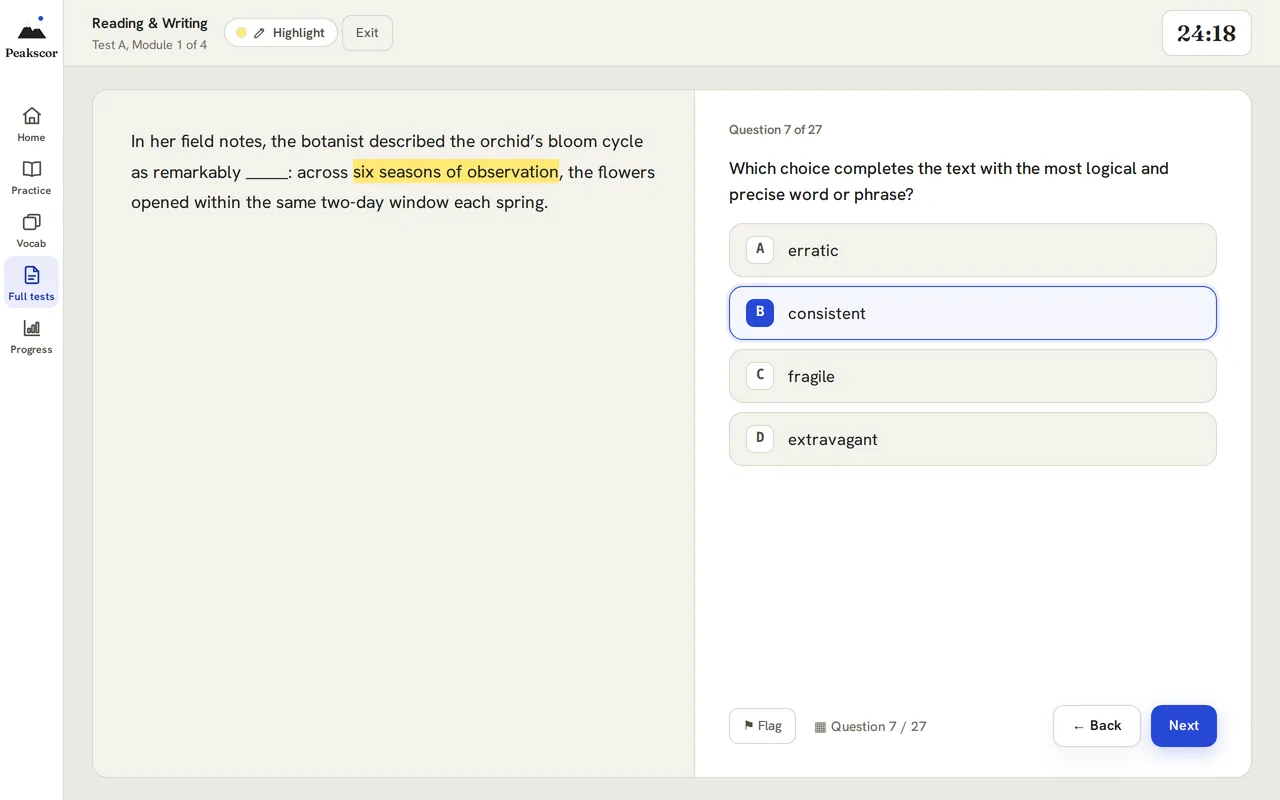
98 questions across four modules, in the digital SAT’s order and on its timing, with a highlighter, a question map and a timer you can see.
How it works
A quick run with three hearts. String right answers together and the questions get harder and the points multiply.
Every question is tagged by domain and skill, and every answer comes with an explanation.
Practice any single skill at any difficulty, or just the questions you got wrong.
Come back tomorrow and climb. Progress shows your accuracy and your strongest skills.
Every question is tagged by section, domain, skill and difficulty, so you can practice exactly what you need. Full tests run like test day: two Reading & Writing modules, a break, then two Math modules.
12 easy, 12 medium and 12 hard questions free every day, each with a full explanation. Filter by section, domain, skill and difficulty. Resets at midnight.
Take any test on official timing, extended 1.5× time, or untimed to focus purely on accuracy.
Four modules in official order. The second module of each section adapts to how you did on the first.
1,023 essential SAT words. Browse the list, flip flashcards, or quiz yourself.
Accuracy across daily practice and full tests, your strongest skills, and the ones that need the most help.
PEAK Survivor, Hole and Peak Defense: three games powered by SAT practice questions.
Explanations
Not just the right letter: how to get there, and why the tempting answer is wrong.
A store raises the price of a jacket by 20%. Later, it lowers the new price by 20%. The final price is what percent of the original price?
Check with $100: $100→then$120→then$96
Up 20% means × 1.20. Down 20% means × 0.80.
1.20 × 0.80 = 0.96
The final price is 96% of the original. That’s B.
The 20% cut is taken from the higher price, so it removes more than the 20% increase added.
Test day
Every Peakscor full test follows this order. In the standard tests, the second module of each section adapts to how you did on the first.
27 questions32 min
27 questions32 min
10 min
22 questions35 min
22 questions35 min
98 questions · 2 hr 14 min of testing, plus the break
Plans
The free plan is the real thing, not a trial. Pro removes the limits. Peak adds the full course and a plan to test day.
$0no card needed
$20a month, or $200 a year
$29a month, or $280 a year
Prices in US dollars. Cancel anytime.
FAQ
The Daily, plus 36 practice questions every day: 12 easy, 12 medium and 12 hard, each with a full explanation. Full-length Test A, Challenge Test 1 and all 1,023 vocabulary words are free too. No card needed.
Pro is $20 a month or $200 a year: unlimited practice with no daily limit, plus every full-length test and Challenge test. Peak is $29 a month or $280 a year: everything in Pro, plus the full Learn course and Peak Plan. Cancel anytime from your account.
98 questions across four modules, in the digital SAT’s order: Reading & Writing Module 1 and Module 2 (27 questions each), a 10-minute break, then Math Module 1 and Module 2 (22 questions each). On official timing that’s 2 hr 14 min of testing. You get estimated section scores and a total at the end.
Yes. In the standard full-length tests, Module 2 of each section is the harder version if you get 60% or more of Module 1 right, and the easier version if you don’t. Challenge tests use the hardest material throughout.
Official timing, extended 1.5× time, or untimed, on every test, including the free ones. Extended time allows 48 minutes for each Reading & Writing module and about 52 for each Math module. Untimed removes the clock so you can focus on accuracy.
A quick run with three hearts. Each right answer builds your streak: the questions get harder as it grows, and your points multiply (×2 from three in a row, ×3 from six). A miss costs a heart and drops you back to easy. Best is your longest streak.
Every day at midnight. You get a fresh 12 easy, 12 medium and 12 hard.
No. Peakscor is an independent SAT practice tool, not affiliated with the College Board. Scores shown are estimates.
Free, no card.
Cross-Text Connections · Lesson 1
A Cross-Text Connections question gives you two short texts on the same topic. Each text makes a claim, and the question asks how the claims connect.
Step 1: pin down each claim. Before you look at the choices, say each text in one short sentence of your own, with who says it: Text 1: Lee says handwritten notes help students remember. Text 2: Ito says they help only when students review them. Keep a text's finding (what was observed or measured) apart from its conclusion (what the author says the finding means).
Step 2: find where the texts touch. Ask which part of Text 1 Text 2 is talking about: the finding, the conclusion, the method used to get the finding, or how far the conclusion reaches.
Step 3: name the relationship in your own words, then find the choice that matches it. The table below lists the main relationships. A text can do more than one of these at once, so match the choice to what Text 2 actually says, not to a label.
| Relationship | What Text 2 does | Question to ask |
|---|---|---|
| Supports | adds evidence for Text 1's claim | Does Text 2 make Text 1 more likely to be right? |
| Challenges | gives a reason to think Text 1's claim is wrong | Would Text 2's author say Text 1 is mistaken? |
| Qualifies | accepts the claim but limits where, when or for whom it holds | Does Text 2 say yes, but only in some cases? |
| Extends | applies the claim to a new case or takes it a step further | Does Text 2 carry the claim somewhere new? |
| Offers another explanation | accepts the finding but explains it differently | Do the texts agree on what happened but not on why? |
| Points out a limitation | questions the method, the sample or the measure behind Text 1's claim | Does Text 2 question how Text 1 got its result? |
Text 1
Ornithologist Maren Holt recorded great tits singing in twelve European cities and in forests nearby. City birds sang noticeably higher-pitched songs than forest birds. Holt argues that the low rumble of traffic drowns out deep notes, so city birds that sing higher are easier for mates and rivals to hear.
Text 2
Biologist Tomasz Wren followed individual great tits in one city park. On weekday mornings, when traffic was heavy, the birds raised the pitch of their songs; on quiet Sunday mornings, the same birds sang lower again. Wren concludes that the birds adjust their songs to the level of background noise around them.
Which choice best describes how Text 2 relates to Text 1?
Text 1
At the inland village site of Torra, occupied about 3,500 years ago, archaeologist Selin Aksoy found hundreds of shells from a species of spiral-shelled snail. Today that snail lives only along the coast, about 200 kilometers away. Aksoy concludes that the villagers obtained the shells through trade with coastal communities.
Text 2
Geologist Pavel Dorn has studied sediment cores from the valley around Torra. The cores show that a large, salty lake covered much of the valley until about 3,000 years ago, and its layers contain thousands of shells of the same snail species. Dorn suggests that Torra's villagers could have gathered the shells from the lake's shores.
Which choice best describes how Text 2 relates to Text 1?
Most choices mention the same subject as the texts, so a familiar topic proves nothing. The relationship word decides the answer: supports, challenges, qualifies, extends. Check that word against what Text 2 actually does.
Some choices give Text 2 a job it doesn't do at all: explaining a method, recommending an action, or comparing species. These sound reasonable because they fit the topic. Look for the part of Text 2 that does that job. If nothing in Text 2 does it or clearly implies it, cross the choice out.
Choose a section, then practice a whole domain or drill a single skill.
Each test mirrors the digital SAT: 98 questions across four modules, 2 hr 14 min on official timing.
Same 98-question format, but every question is drawn from the toughest SAT material: Challenging-tier math throughout and the hardest reading.
Study the classic SAT vocabulary list. Browse, flip flashcards, or quiz yourself.
Practice free every day. Pro removes the limits. Peak adds the full course and a plan to test day.
Prices in USD. Switch or cancel your plan at any time.
Online payment hasn’t launched, so nothing here asks for a card. Everything on the free plan stays free.
Save your progress and pick up where you left off.
Your account keeps game coins, characters and map progress in sync across devices. Practice history stays on this device.