Start here: 20 questions, about 28 minutes. You see your level in every domain and which lessons to take first. Free, no card. You also get 36 practice questions a day: 9 easy, 9 medium, 9 hard and 9 challenging. See what’s free
×2 ×3Streaks pay. ×2 from three in a row, ×3 from six.
BestYour longest streak. Beat it tomorrow.
Full-length tests
The real test, rehearsed.
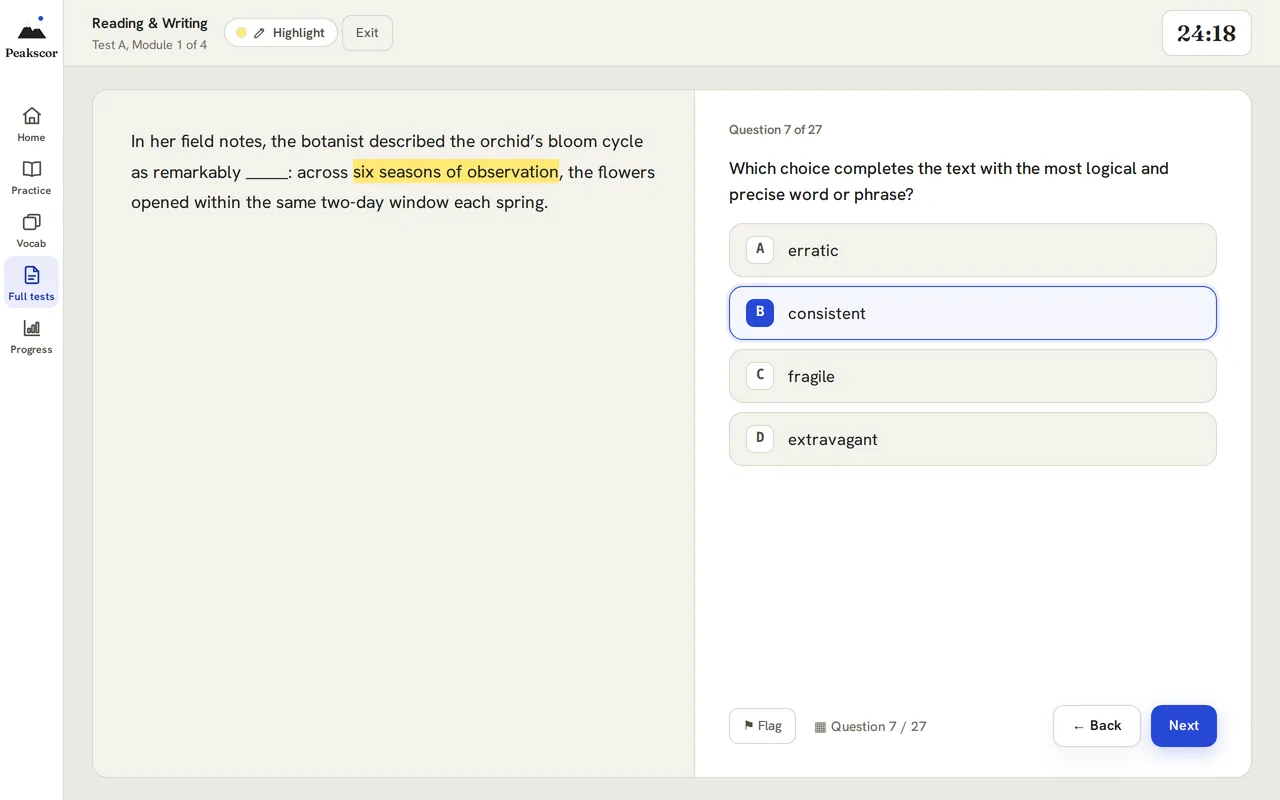
98 questions across four modules, in the digital SAT’s order and on its timing, with a highlighter, a question map and a timer you can see.
peakscor.com/tests
How it works
One run a day. One skill at a time.
The DailySTEP 4
Medium×2♥♥♥40
If 2x − 7 = 11, what is the value of 3x?
A9
B18
C27
Best: 3
1
Play the Daily.
A quick run with three hearts. String right answers together and the questions get harder and the points multiply.
Expression of IdeasTransitions
Jazz pianist Mary Lou Williams composed hundreds of works. ______ she wrote arrangements for bands led by Duke Ellington and Benny Goodman.
AHowever,Your pick
BIn addition,Correct
Why: the second sentence adds another accomplishment. Nothing is being contrasted.
2
Miss one, learn why.
Every question is tagged by domain and skill, and every answer comes with an explanation.
Practice
TransitionsHardIncorrect10 questions
Transitions40%
Boundaries78%
Inferences85%
Example accuracy by skill
3
Drill that skill.
Practice any single skill at any difficulty, or just the questions you got wrong.
Daily scoreEXAMPLE WEEK
709080110120140
New best: 140
4
Beat your best.
Come back tomorrow and climb. Progress shows your accuracy and your strongest skills.
Built around the real SAT blueprint.
Every question is tagged by section, domain, skill and difficulty, so you can practice exactly what you need. Full tests run like test day: two Reading & Writing modules, a break, then two Math modules.
The Daily, plus 36 practice questions every day: 9 easy, 9 medium, 9 hard and 9 challenging, each with a full explanation. Full-length Test A, Challenge Test 1 and all 1,023 vocabulary words are free too, as are the 20-question diagnostic, each Learn module’s overview and first lesson, and PEAK Survivor’s first map. No card needed.
Pro is $20 a month or $200 a year: unlimited practice with no daily limit, plus every full-length test and Challenge test, and every game map and level. Peak is $29 a month or $280 a year: everything in Pro, plus the full Learn course and Peak Plan. Cancel anytime from your account.
98 questions across four modules, in the digital SAT’s order: Reading & Writing Module 1 and Module 2 (27 questions each), a 10-minute break, then Math Module 1 and Module 2 (22 questions each). On official timing that’s 2 hr 14 min of testing. You get estimated section scores and a total at the end.
Yes. In the standard full-length tests, Module 2 of each section is the harder version if you get 60% or more of Module 1 right, and the easier version if you don’t. Challenge tests use the hardest material throughout.
Official timing, extended 1.5× time, or untimed, on every test, including the free ones. Extended time allows 48 minutes for each Reading & Writing module and about 52 for each Math module. Untimed removes the clock so you can focus on accuracy.
A quick run with three hearts. Each right answer builds your streak: the questions get harder as it grows, and your points multiply (×2 from three in a row, ×3 from six). A miss costs a heart and drops you back to easy. Best is your longest streak.
Every day at midnight Central Time. You get a fresh 9 easy, 9 medium, 9 hard and 9 challenging.
No. Peakscor is an independent SAT practice tool, not affiliated with the College Board. Scores shown are estimates.
Your next point starts today.
Free, no card.
Nonlinear equations and systems · Lesson 2
The discriminant and number of solutions
The discriminant is the part of the quadratic formula under the square root: b2−4ac, for ax2+bx+c=0. Its sign tells you how many real solutions there are without solving.
Positive: two real solutions. Zero: exactly one real solution, because ±0 gives the same value twice. Negative: no real solutions, because no real number squares to a negative.
On a graph, the solutions are the x-intercepts of y=ax2+bx+c. Two solutions means the parabola crosses the x-axis twice. One solution means its vertex sits exactly on the x-axis. No real solutions means it never reaches the x-axis.
Always get standard form first. In x2+25=10x, the 10x belongs on the left: x2−10x+25=0, so b=−10 and the discriminant is 100−100=0. Exactly one solution, x=5.
For *exactly one solution, what is k?*, set the discriminant equal to 0 and solve for k. For no real solutions, solve discriminant <0. For two real solutions, solve discriminant >0.
Sum and product. When ax2+bx+c=0 has two solutions, their sum is −ab and their product is ac. If a question asks only for the sum or product, use these and skip solving. For 2x2−7x+3=0, the sum is 27 and the product is 23 (the solutions are 3 and 21).
y=x2−4x+c for c=3, c=4 and c=6Three upward-opening parabolas, each with its lowest point at x = 2. The lowest one (c = 3) crosses the x-axis twice, at (1, 0) and (3, 0). The middle one (c = 4) touches the x-axis only at its vertex, (2, 0). The highest one (c = 6) has its vertex at (2, 2) and never reaches the x-axis.
Worked example Easy
x2+49=14x
How many distinct real solutions does the given equation have?
AZero
BExactly oneAnswer
CExactly two
DInfinitely many
How to solve it
Standard form first: subtract 14x from both sides, x2−14x+49=0.
A discriminant of 0 means exactly one real solution. Indeed x2−14x+49=(x−7)2, so x=7.
Why each choice is right or wrong
A. Incorrect. This computes the discriminant before moving 14x, using b=0 and c=49: 0−196<0. Rewrite in standard form first, so b=−14.
B. Correct. In standard form, x2−14x+49=0, and 196−196=0. The equation is (x−7)2=0, with the single solution x=7.
C. Incorrect. This adds 4ac instead of subtracting it: 196+196>0. The discriminant is b2−4ac, which is 0 here.
D. Incorrect. A quadratic equation has at most two solutions. Infinitely many would need the two sides to be identical.
Worked example Medium
2x2−12x+k=0
In the given equation, k is a constant. The equation has exactly one real solution. What is the value of k?
A−18
B6
C18Answer
D36
How to solve it
Exactly one solution means the discriminant is 0.
a=2, b=−12, c=k: (−12)2−4(2)(k)=144−8k.
144−8k=0, so k=18.
Check: 2x2−12x+18=2(x−3)2, which is 0 only at x=3.
Why each choice is right or wrong
A. Incorrect. This adds 4ac instead of subtracting it: 144+8k=0. With k=−18, the discriminant is 144+144=288, so there are two solutions.
B. Incorrect. This takes half of 12 and stops. Dividing by 2 gives x2−6x+2k=0, a perfect square only when 2k=9, the square of half of 6. With k=6, the discriminant is 144−48=96, so there are two solutions.
C. Correct. Setting the discriminant to 0 gives 144−8k=0, so k=18, and the equation becomes 2(x−3)2=0.
D. Incorrect. This leaves out a=2: 144−4k=0 gives k=36. The discriminant is b2−4ac, and here a=2.
Worked example Hard
3x2−21x+5=0
What is the sum of the solutions to the given equation?
A−7
B35
C7Answer
D21
How to solve it
Check that there are two solutions: (−21)2−4(3)(5)=441−60=381>0.
The sum of the solutions is −ab=−3−21=7.
Solving with the formula would give 621±381. Adding them, the square roots cancel and leave 642=7, the same answer with much more work.
Why each choice is right or wrong
A. Incorrect. This uses ab and forgets the negative sign: 3−21=−7. The sum is −ab.
B. Incorrect. 35 is ac, the product of the solutions, not the sum.
C. Correct. The sum of the solutions is −ab=321=7, and the discriminant, 381, is positive, so there are two solutions to add.
D. Incorrect. 21 is −b without dividing by a=3. The sum is −ab=321=7.
Trap Using the discriminant before standard form
b and c only mean something when every term is on one side and 0 is on the other. In x2+49=14x, b is −14, not 0. Move everything to one side, then read a, b and c with their signs.
Trap Mixing up one solution and no solution
Zero is the boundary. A discriminant of exactly 0 means one solution; a negative discriminant means none. In a no real solutions question, the value of k that makes the discriminant 0 is often a choice, and it gives one solution, not zero.
Desmos When Desmos is faster
To count solutions, graph the equation with everything on one side, such as y=x2−14x+49, and count the x-intercepts. You can also graph each side as its own y= and count the crossings.
For a constant such as k, type y=2x2−12x+k. Because k isn't defined, Desmos offers to add a slider. Add it, click the slider's value and type each answer choice. Look for the choice that makes the vertex sit on the x-axis (one solution) or lifts the parabola off it (none).
A vertex that sits just above or just below the axis can look like it touches. If the picture is close, compute b2−4ac by hand. For a sum or product question, −ab or ac is faster than any graph.
Your progress
How you’re doing across daily practice and full-length tests.
Choose a section, then practice a whole domain or drill a single skill.
Difficulty
Status
Session
Timing
Full-length tests
Each test mirrors the digital SAT: 98 questions across four modules, 2 hr 14 min on official timing.
A little harder than the real SAT. These tests can run slightly tougher than test day, which makes them good practice: if you can handle these, the real one should feel easier. No question appears in more than one test, Challenge Tests included.
Challenge Tests Hardest of the hardest
Same 98-question format, but every question is drawn from the toughest SAT material: Challenging-tier math throughout and the hardest reading.
Vocab
Study the classic SAT vocabulary list. Browse, flip flashcards, or quiz yourself.
Free every day. Pro when you're serious.
Practice free every day. Pro removes the limits. Peak adds the full course and a plan to test day.
FREE
$0forever
✓ 9 easy + 9 medium + 9 hard + 9 challenging daily
✓ Practice by any SAT domain
✓ Explanations on every question
✓ Test A and Challenge Test 1
✓ Each Learn module’s overview and first lesson
✓ The 20-question Learn diagnostic
✓ PEAK Survivor’s first map, plus the opening levels of Hole and Peak Defense
PRO
$200/ year
About $16.67 a month, save $40
✓ Everything in Free
✓ Unlimited daily practice
✓ Every full-length and Challenge test
✓ Every game map and level, with progress saved
Full course and plan
PEAK
$280/ year
About $23.33 a month, save $68
✓ Everything in Pro
✓ Every Learn lesson, summary and mastery quiz
✓ Peak Plan: a day-by-day plan to test day
✓ Cancel anytime
Prices in USD. Switch or cancel your plan at any time.
Pro checkout isn’t open yet
Online payment hasn’t launched, so nothing here asks for a card. Everything on the free plan stays free.
Peak, yearly$280 / year
Log in
Save your progress and pick up where you left off.
Your account keeps game coins, characters and map progress in sync across devices. Practice history stays on this device.
Your account
▦ Calculator
Drag the bar to move it, and the corner to resize it