Free
$0no card needed
- The Daily, every day
- 36 practice questions a day, each with an explanation: 12 easy, 12 medium, 12 hard
- Full-length Test A and Challenge Test 1
- All 1,023 vocabulary words: browse, flashcards and quiz
Reach your peak.
A quick run every day, an explanation for every question, and full-length tests on official timing.
Full-length tests
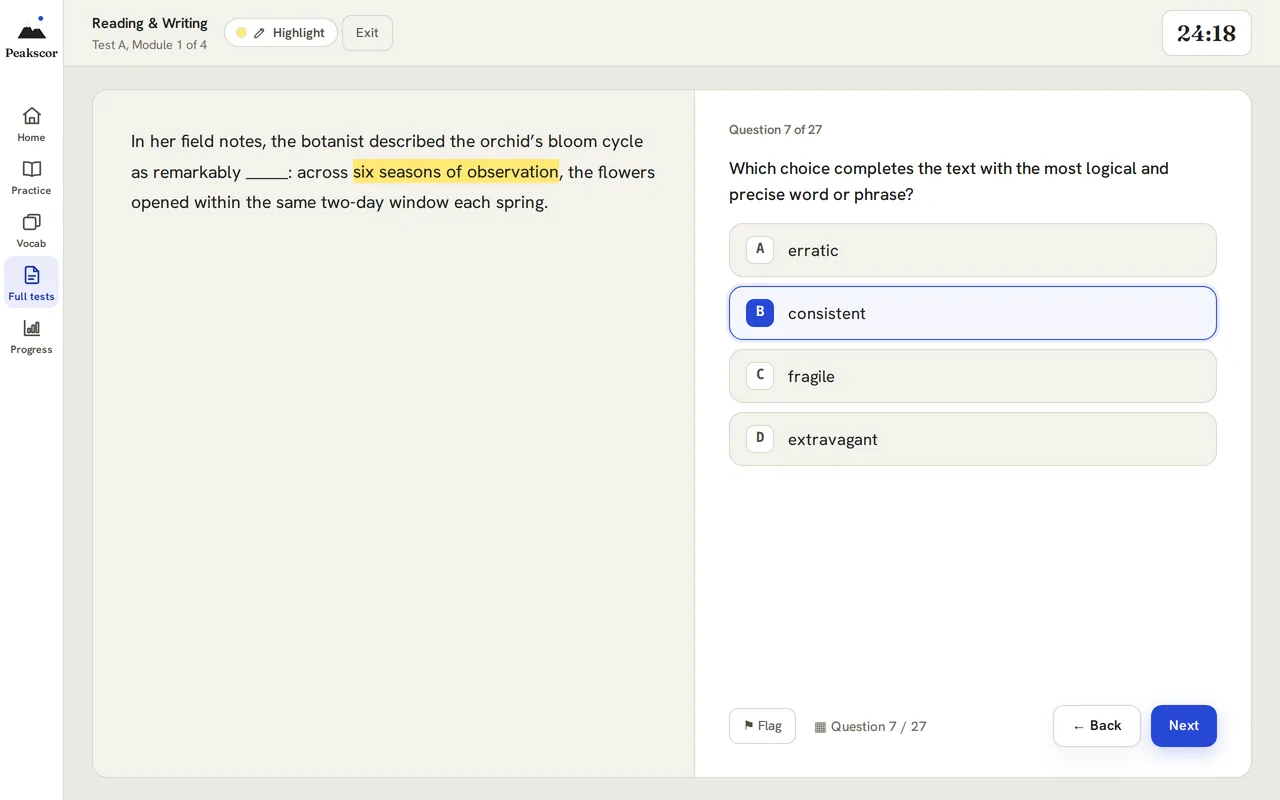
98 questions across four modules, in the digital SAT’s order and on its timing, with a highlighter, a question map and a timer you can see.
How it works
A quick run with three hearts. String right answers together and the questions get harder and the points multiply.
Every question is tagged by domain and skill, and every answer comes with an explanation.
Practice any single skill at any difficulty, or just the questions you got wrong.
Come back tomorrow and climb. Progress shows your accuracy and your strongest skills.
Every question is tagged by section, domain, skill and difficulty, so you can practice exactly what you need. Full tests run like test day: two Reading & Writing modules, a break, then two Math modules.
12 easy, 12 medium and 12 hard questions free every day, each with a full explanation. Filter by section, domain, skill and difficulty. Resets at midnight.
Take any test on official timing, extended 1.5× time, or untimed to focus purely on accuracy.
Four modules in official order. The second module of each section adapts to how you did on the first.
1,023 essential SAT words. Browse the list, flip flashcards, or quiz yourself.
Accuracy across daily practice and full tests, your strongest skills, and the ones that need the most help.
PEAK Survivor, Hole and Peak Defense: three games powered by SAT practice questions.
Explanations
Not just the right letter: how to get there, and why the tempting answer is wrong.
A store raises the price of a jacket by 20%. Later, it lowers the new price by 20%. The final price is what percent of the original price?
Check with $100: $100→then$120→then$96
Up 20% means × 1.20. Down 20% means × 0.80.
1.20 × 0.80 = 0.96
The final price is 96% of the original. That’s B.
The 20% cut is taken from the higher price, so it removes more than the 20% increase added.
Test day
Every Peakscor full test follows this order. In the standard tests, the second module of each section adapts to how you did on the first.
27 questions32 min
27 questions32 min
10 min
22 questions35 min
22 questions35 min
98 questions · 2 hr 14 min of testing, plus the break
Plans
The free plan is the real thing, not a trial. Pro removes the limits. Peak adds the full course and a plan to test day.
$0no card needed
$20a month, or $200 a year
$29a month, or $280 a year
Prices in US dollars. Cancel anytime.
FAQ
The Daily, plus 36 practice questions every day: 12 easy, 12 medium and 12 hard, each with a full explanation. Full-length Test A, Challenge Test 1 and all 1,023 vocabulary words are free too. No card needed.
Pro is $20 a month or $200 a year: unlimited practice with no daily limit, plus every full-length test and Challenge test. Peak is $29 a month or $280 a year: everything in Pro, plus the full Learn course and Peak Plan. Cancel anytime from your account.
98 questions across four modules, in the digital SAT’s order: Reading & Writing Module 1 and Module 2 (27 questions each), a 10-minute break, then Math Module 1 and Module 2 (22 questions each). On official timing that’s 2 hr 14 min of testing. You get estimated section scores and a total at the end.
Yes. In the standard full-length tests, Module 2 of each section is the harder version if you get 60% or more of Module 1 right, and the easier version if you don’t. Challenge tests use the hardest material throughout.
Official timing, extended 1.5× time, or untimed, on every test, including the free ones. Extended time allows 48 minutes for each Reading & Writing module and about 52 for each Math module. Untimed removes the clock so you can focus on accuracy.
A quick run with three hearts. Each right answer builds your streak: the questions get harder as it grows, and your points multiply (×2 from three in a row, ×3 from six). A miss costs a heart and drops you back to easy. Best is your longest streak.
Every day at midnight. You get a fresh 12 easy, 12 medium and 12 hard.
No. Peakscor is an independent SAT practice tool, not affiliated with the College Board. Scores shown are estimates.
Free, no card.
Equivalent expressions · Lesson 4
A rational expression is a fraction with polynomials on the top and bottom. You handle it the way you handle number fractions.
Simplify by factoring the top and bottom completely, then canceling the factors they share: . You may cancel only factors, whole pieces that multiply. You can't cancel the in , because is a term being added.
Canceling can hide a restriction. The original fraction is undefined at and , but is defined at . The two are equal wherever the original is defined. SAT questions usually state a condition such as *for * so this doesn't matter; if one asks you to solve an equation, a value that makes an original denominator 0 can't be a solution.
Add or subtract over a common denominator. Factor the denominators, build the least common denominator, and rewrite each fraction with it. When you subtract, put the whole second numerator in parentheses: .
Rewrite as a whole part plus a remainder by writing the numerator in terms of the denominator: .
Which expression is equivalent to for ?
Which expression is equivalent to for ?
Which expression is equivalent to for ?
In nothing cancels: the 's are terms of sums. Cancel only after factoring, and only whole factors. A quick test catches a bad cancel: substitute a number such as into the original and into your answer. If the values differ, your answer is wrong.
When you subtract a fraction, its whole numerator is subtracted. Write it in parentheses, such as , before you distribute. The choice with instead of is the trap.
Graph the original as and each choice on its own line. Type fractions with the slash key. The equivalent choice lies on top of the original curve wherever the original is defined.
If the question says *for *, compare the graphs only to the right of . A simplified form can be defined at a value where the original isn't, and that single point doesn't make it wrong.
You can also compare numbers: type the original with a value such as 3 in place of , then each choice the same way. A choice with a different value is wrong. One matching value doesn't prove equivalence, so if two choices match, try a second value.
Choose a section, then practice a whole domain or drill a single skill.
Each test mirrors the digital SAT: 98 questions across four modules, 2 hr 14 min on official timing.
Same 98-question format, but every question is drawn from the toughest SAT material: Challenging-tier math throughout and the hardest reading.
Study the classic SAT vocabulary list. Browse, flip flashcards, or quiz yourself.
Practice free every day. Pro removes the limits. Peak adds the full course and a plan to test day.
Prices in USD. Switch or cancel your plan at any time.
Online payment hasn’t launched, so nothing here asks for a card. Everything on the free plan stays free.
Save your progress and pick up where you left off.
Your account keeps game coins, characters and map progress in sync across devices. Practice history stays on this device.